Peace is something that was intended for us by our very creation. We have rejected it, but we can come back.
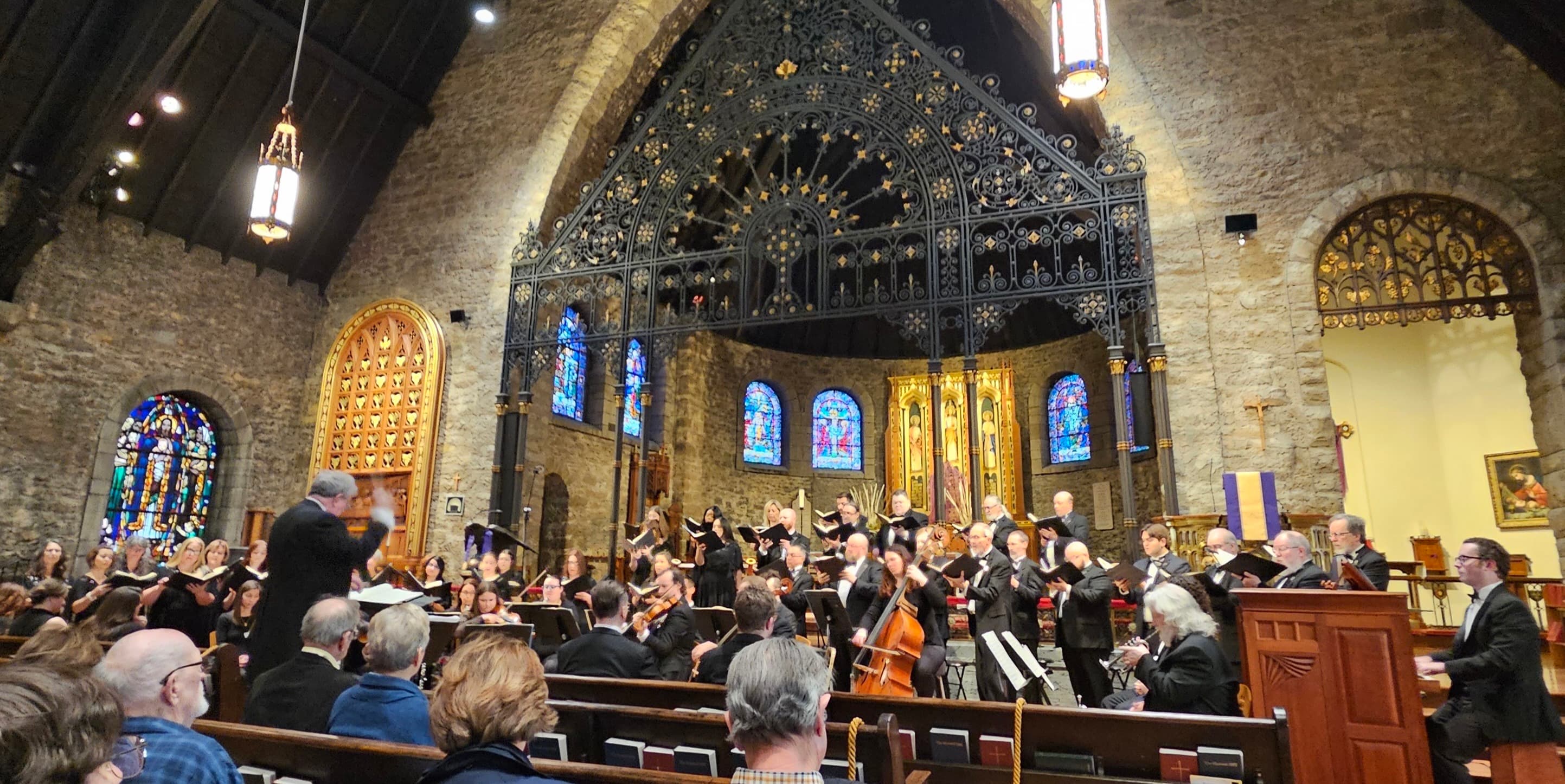
O quam mirabilis. St. Hildegard of Bingen’s hymn of cosmic harmony opened Vision of Peace, the William Baker Festival Singers’ season concert at 3 p.m. on November 2, 2025, at St. Mary’s Episcopal Church. Around it: Jean Berger, Samuel Barber, Anton Bruckner, Felix Mendelssohn, and composer-in-residence Sean Sweeden.
The concert centered on peace. Baker was hesitant at first to take up so well-worn a subject. “I try to come up with a theme for our season every year, and what kept resonating in my mind was peace,” he said. “It had nothing to do with anything going on in the world, except it just floated in my head. And I’m going to tell you, I rejected it. I said, OK, I’m not going to do peace. Everybody does peace. Who in this world is not interested in peace? I did not want to be put in that niche or that pigeonhole, but it kept coming back to me.”
What changed his mind was hearing Vox Venti, the Foundation’s Chicago choir, sing Hildegard’s O Quam Mirabilis. “That got me thinking,” Baker said. “Peace is something that was intended for us by our very creation. Peace was created in us and we have rejected it, but we have an opportunity to come back. We can find peace in our daily lives, in the sleeping of a child, the beauty of the ocean. When I’m sitting out on the back porch with a glass of wine, looking through the trees in my backyard at the blue Kansas sky, my spirit is serene. So all of this started kicking around, and in 30 minutes, I had the program.”
The women of the Festival Singers opened with Hildegard, followed by Berger’s Vision of Peace. “Berger was Jewish and was born in 1909 in Westphalia,” Baker said. “When the Nazis began persecuting Jews, he first went to Paris and then he escaped the Nazis again in Paris and fled to Rio de Janeiro, where he did a number of pieces in Portuguese. One of his great pieces is called Brazilian Psalm. Finally, he found his way to the United States during World War II. He joined the American army during the war, and then he became an American citizen before the end of the war. He was always an anti-war person, and his Vision of Peace is considered one of his great anti-war statements.”
Three nineteenth-century hymns followed, sung in part by the men: Come, Ye Disconsolate, the Sacred Harp tune Pensive Dove, and Morning Trumpet. Baker, an Atlanta native, has a long affection for that repertoire. “There were people in the Festival Singers who said, ‘We can’t believe there’s a Sacred Harp hymn you haven’t done before.’”
He then handed the baton to Christine Freeman, associate music director, for Bruckner’s Virga Jesse and Mendelssohn’s Verleih uns Frieden gnädiglich, Luther’s paraphrase of Da pacem Domine. Virga Jesse builds to pacem Deus reddidit — “God has restored peace” — and a luminous Alleluia. Mendelssohn’s short chorale cantata, written in 1831, holds a prayerful line from start to finish.
The program also held two works by Atlanta-born composer Daniel Elder, Ballade to the Moon and Lullaby. “His music is so well-regarded that the great Westminster Choir did an entire album of his pieces,” Baker said. “I think the only other composer that got an entire album of pieces before Elder by the Westminster Choir was Bach.”
Since the late 1980s the Festival Singers have kept a composer-in-residence. Sweeden, the fourth, was represented by new work including his arrangement of Over the Rainbow, which Baker called heartbreakingly beautiful. Also on the desks: Barber’s Agnus Dei, the choral setting of the Adagio for Strings; René Clausen’s Ubi Caritas; and Kenneth Jennings’s The Lord Is the Everlasting God.
“I have about five or six settings of the Ubi Caritas, and my favorite of the five is whichever one I’m doing at the time,” Baker said. “But I think René Clausen’s setting, which has a little bit more of the text, has got to be one of the most beautiful and one of the most compelling. Where charity and love are, God is there. Let us keep our minds free of division. May there be an end to malice and strife and quarrels.”
The concert closed with spirituals, a Festival Singers specialty: Alice Parker’s Sometimes I Feel Like a Motherless Child and Deep River, and Robert Ray’s He Never Failed Me Yet. “What can be more about peace than Deep River,” Baker said, “the promised land where all is peace.”
Vision of Peace — William Baker Festival Singers. November 2, 2025, 3 p.m., St. Mary’s Episcopal Church, 1307 Holmes, Kansas City.
Patrick Neas wrote this feature for KC Arts Beat. It is printed here in full because it has no separate article page on the publisher’s site.